Residential · Rim Joists & Sill Plates
Rim joist insulation in Winnipeg
Direct answer
The rim joist is the band of lumber where your floor framing sits on the foundation. It's roughly 40 square feet in a typical bungalow, and per square foot it's the leakiest assembly in the house. End-grain wood, sill-plate gaps and every utility penetration the trades ever drilled let outside air pour in under your floor. Batts don't stop it; air moves straight through fibre. Two to three inches of closed-cell spray foam (verified R-11.1 at 2 inches, CCMC 14133-L) does four jobs in one pass: air-seals the leaks, insulates the wood, meets the code vapour-barrier threshold at 2 inches, and closes a common radon entry route. Ecologic sprays rim joists standalone or alongside basement walls, installed to CAN/ULC-S705.2, quoted in writing.
Sources: CCMC 14133-L · NRCan "Keeping the Heat In" §6 · CAN/ULC-S705.1 (verified July 2026)
01 The anatomy
Forty square feet of wood between your floor and February.
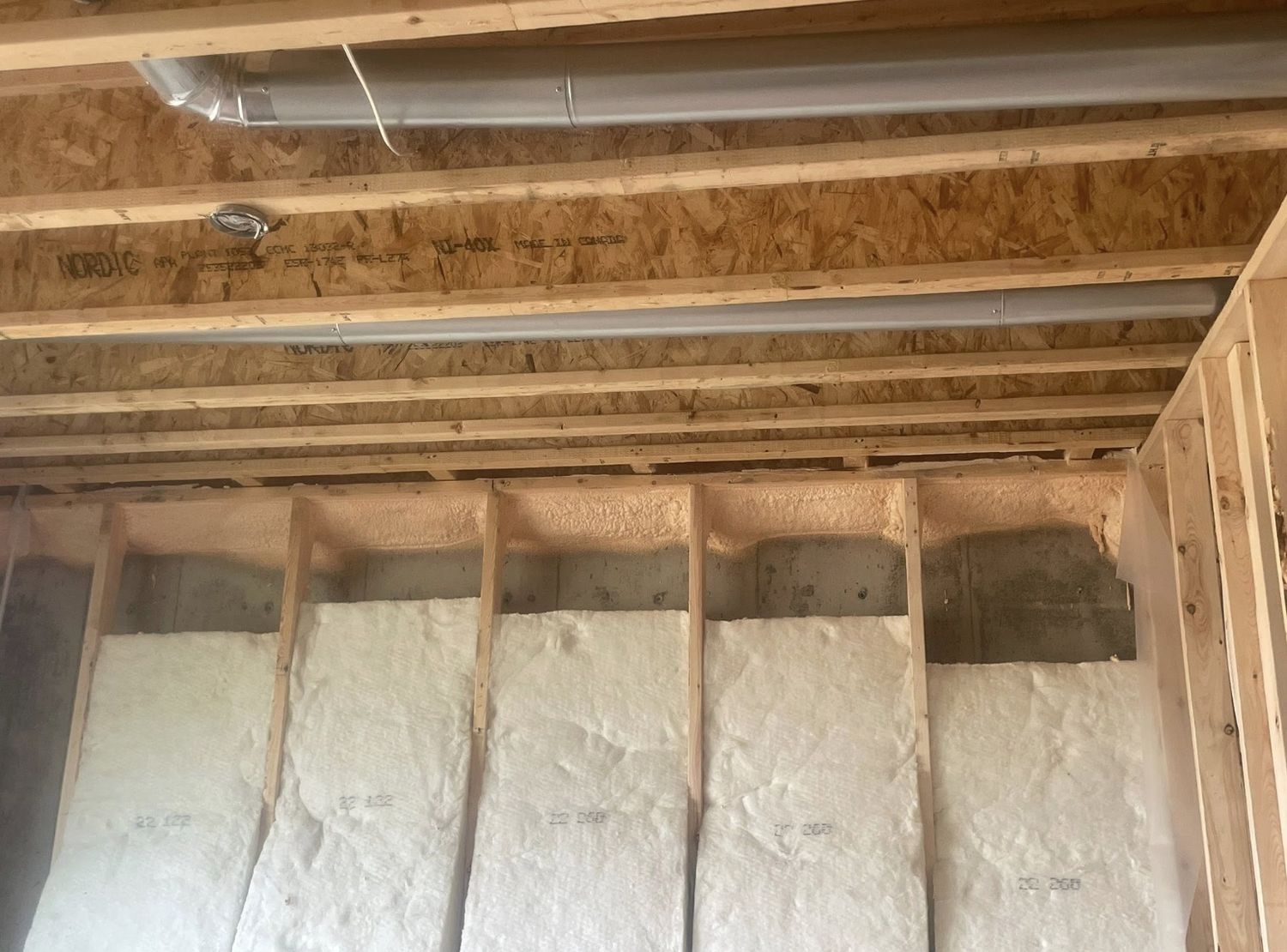
Walk into an unfinished basement and look up at the perimeter, just below the main floor. That wooden band closing off the ends of your floor joists is the rim joist (band joist, if you prefer), resting on the sill plate that sits on the concrete. Together they run the entire perimeter of the house.
Everything above grade at that height is separated from a Winnipeg winter by that band: often a single thickness of lumber, sometimes with a slumped batt in front of it. It's where the wood frame meets the concrete foundation, where the framing was cut and butted on site, and where the electrician, the plumber, the gas fitter and the cable installer all drilled through over the decades. In a typical bungalow the band totals roughly 40 square feet, and it costs you more heat than an area that small has any business losing.
If your "basement" is 4 feet tall, the same band exists. See crawl space insulation, where the rim is part of the encapsulation.
02 The failure
Why the rim leaks, and why the batt in front of it doesn't help.
Three reasons the rim outleaks everything else. The wood there is largely end grain, which moves air and moisture far more readily than face lumber. The joints (sill to concrete, rim to sill, sheathing to rim) were never designed as air seals, and the house has been flexing them through freeze-thaw cycles since it was built. And the band is where services enter: wiring, plumbing, gas, dryer vents, cable. Every penetration is a hole with caulk that gave up years ago.
The standard treatment for decades was to stuff a fibreglass batt into each rim bay. It fails on physics: fibre slows conductive heat but does nothing to stop moving air, and moving air is the rim's whole problem. Worse, warm interior air passing through the batt reaches cold wood and condenses there. A batt in a rim bay can make the wood wetter than no batt at all. Pull one out in February and you'll often find frost on the inside of the rim.
Why batts fail at the rim
1. Air moves straight through fibre, so the leaks keep leaking.
2. Interior moisture rides that air to the cold wood and condenses.
3. Nothing seals the sill gap or the penetrations.
4. Damp wood plus organic dust is a mould starter kit.
The rim needs an air barrier first and an insulator second. Fibre is neither where air is moving.
03 The fix
Two to three inches of closed-cell. Four jobs done at once.
Air seal
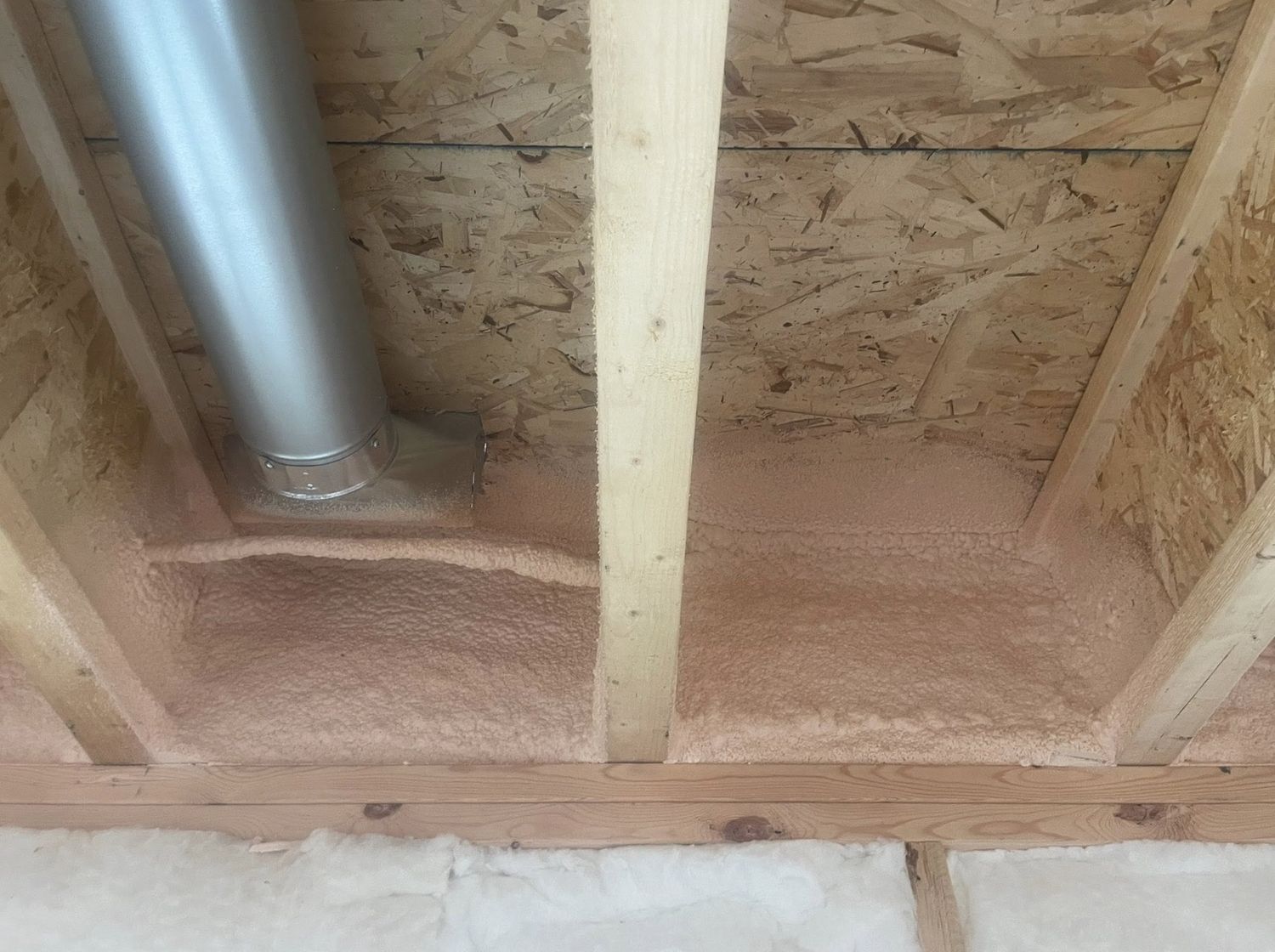
The foam bonds to the wood and the concrete, filling the sill gap, the joints and every penetration in the bay. The leak paths close for good.
Insulate
Verified LTTR (CAN/ULC-S770-15, CCMC 14133-L). Two inches puts R-11.1 on the band; 3 inches, R-17.5, on lumber that had next to nothing.
Vapour protect
At 2 inches the foam's design permeance is 39 ng/(Pa·s·m²) against the code limit of 60, so the foam itself is the vapour barrier. No poly to fit around forty joist bays, no condensation plane left behind it.
Radon-harden
The sill-plate and top-of-wall joints are soil-gas entry routes, and Manitoba has real radon exposure: Health Canada's 2012 survey found 19% of homes over the 200 Bq/m³ guideline. Sealing the rim closes one path; our radon gas barrier page covers the rest.
04 The economics
Small job, big return. Biggest when it rides along.
The rim earns its "highest-ROI" label because the leakage fixed per dollar is hard to beat anywhere else in the house. The material quantity is tiny: 40 ft² at 3 inches is about 120 board feet, and Prairie closed-cell runs $1.75–$2.50 per board foot installed. Where the standalone price grows is mobilization: the rig, the crew and the setup cost roughly the same for a rim as for a full basement, so the per-foot rate is highest when the rim is the whole job.
Which points at the obvious move: bundle it. Rim joists are sprayed in the same visit as basement foundation walls with almost no added setup, and the same logic applies during crawl space encapsulation or a garage job. Renovating the basement next year? Do the rim then. Not renovating anything? A standalone rim job is still worth pricing — we quote it in writing either way, and the CCMC listing puts re-occupancy at 25 hours for a ventilated retrofit install.
Where this page's honesty section lands: if your rim bays are already foamed, or your house sits on a slab with no rim at all, there's nothing here to sell you. And rot or insect damage at the sill needs a carpenter before it needs foam, because spraying over bad wood just hides it.
| Parameter | Value |
|---|---|
| Typical area (bungalow) | ~40 ft² |
| Depth | 2–3 inches closed-cell |
| R-value at 3 in | R-17.5 (LTTR, S770-15) |
| Vapour barrier threshold | 2 in (permeance 39 vs 60) |
| Material at 3 in | ~120 board feet |
| Re-occupancy (retrofit, ventilated) | 25 hours |
05 Questions
Rim joists, answered
What is a rim joist?
The band of lumber running around the top of your foundation, closing off the ends of the floor joists. Some people call it the band joist; with the plate it sits on, it makes up the sill area. Stand in an unfinished basement and look at the wood perimeter just below the main floor: that's it. In a typical Winnipeg bungalow it adds up to roughly 40 square feet of wood, gaps and utility holes separating your floor framing from the outdoors.
Are rim joists worth spray foaming?
Per square foot, it's usually the highest-return insulation work in the house. The rim leaks more air than any comparable area of wall or window, the fix is small, and one material does the sealing, the insulating and the vapour protection at once. If your insulation budget covers exactly one job this year, this is the one we'd point most Winnipeg homeowners at.
How thick should rim joist spray foam be?
Two to three inches of closed-cell. At 2 inches the foam passes the code vapour-barrier threshold (design permeance 39 against the limit of 60) and delivers R-11.1 with the air seal included; 3 inches brings the band to R-17.5. Thinner passes seal but underinsulate; going much thicker buys little in a 40 ft² area. We spray to the depth the assembly needs and record it.
Sources: CCMC 14133-L · CAN/ULC-S705.1
Can I spray foam my own rim joists with a DIY kit?
A handy owner can, and the rim is the least risky place to try: small area, forgiving substrate. Go in clear-eyed: kit foam costs several times more per board foot than contractor foam, off-ratio or cold-surface mistakes produce foam that shrinks or never cures (CBC investigations have documented what bad spray foam does to a house), code may still require a thermal barrier over it, and kit foam carries no CCMC-verified R-value paperwork if a rebate is in play. Professional two-component work is installed to CAN/ULC-S705.2 with daily documented testing.
What does a rim-joist-only job cost in Winnipeg?
The material math is small: 40 ft² at 3 inches is about 120 board feet, and Prairie closed-cell runs $1.75–$2.50 per board foot installed. But a rig and crew cost the same to mobilize for 120 board feet as for 2,400, so standalone rim work carries a proportionally higher rate than the same foam bundled with basement walls. We quote both ways in writing; if basement work is anywhere in your plans, doing the rim in the same visit is the cheaper path.
Forty square feet. One visit. Done for decades.
Standalone or bundled with basement walls. Written quote, math shown.