0.5lb Light-Density · Grizzly 005 OC LD
Open-cell spray foam in Winnipeg
Direct answer
Open-cell spray foam is a 0.5lb light-density foam. It costs less per board foot than closed-cell, fills irregular cavities completely and absorbs airborne sound well. But it is vapour-open (water-vapour permeance 1580 ng/(Pa·s·m²) at 25 mm), so in Winnipeg's climate it needs a separate 6-mil poly vapour barrier under NBC 9.25, and it has no business below grade or against concrete. Ecologic is licensed to install Grizzly 005 OC LD alongside our 2lb closed-cell and 3lb roofing foams. We use open-cell where it earns its place: interior partitions for sound, and some above-grade cavities where budget drives the job. For basements, rim joists, crawl spaces and steel buildings we quote closed-cell instead, and this page explains why.
Sources: NBC 9.25 · CUFCA · manufacturer technical data
01 The material
Half a pound per cubic foot, and that changes everything
Open-cell foam is sprayed the same way as closed-cell: two liquid components, mixed at the gun, expanding on the surface. The difference is in the cells. Closed-cell foam traps its blowing agent in millions of sealed bubbles. Open-cell foam's bubbles burst as they form, leaving a soft, spongy matrix of interconnected air pockets at roughly a quarter of the density.
That structure has consequences you can't negotiate with:
It expands far more. Open-cell fills deep, irregular cavities in a single pass and reaches gaps a batt installer would stuff or skip. As an air seal against drafts, it performs well.
It insulates less per inch. It delivers R-3.5 per inch (ASTM C518, manufacturer's TDS), roughly 60 percent of what our closed-cell delivers. In a thin cavity that shortfall matters; in a deep one it may not.
It is vapour-open and it absorbs water. Moisture vapour passes through the material, and liquid water soaks in and stays. This single property decides most of the where-it-fits map below.
The product we spray
Grizzly 005 OC LD
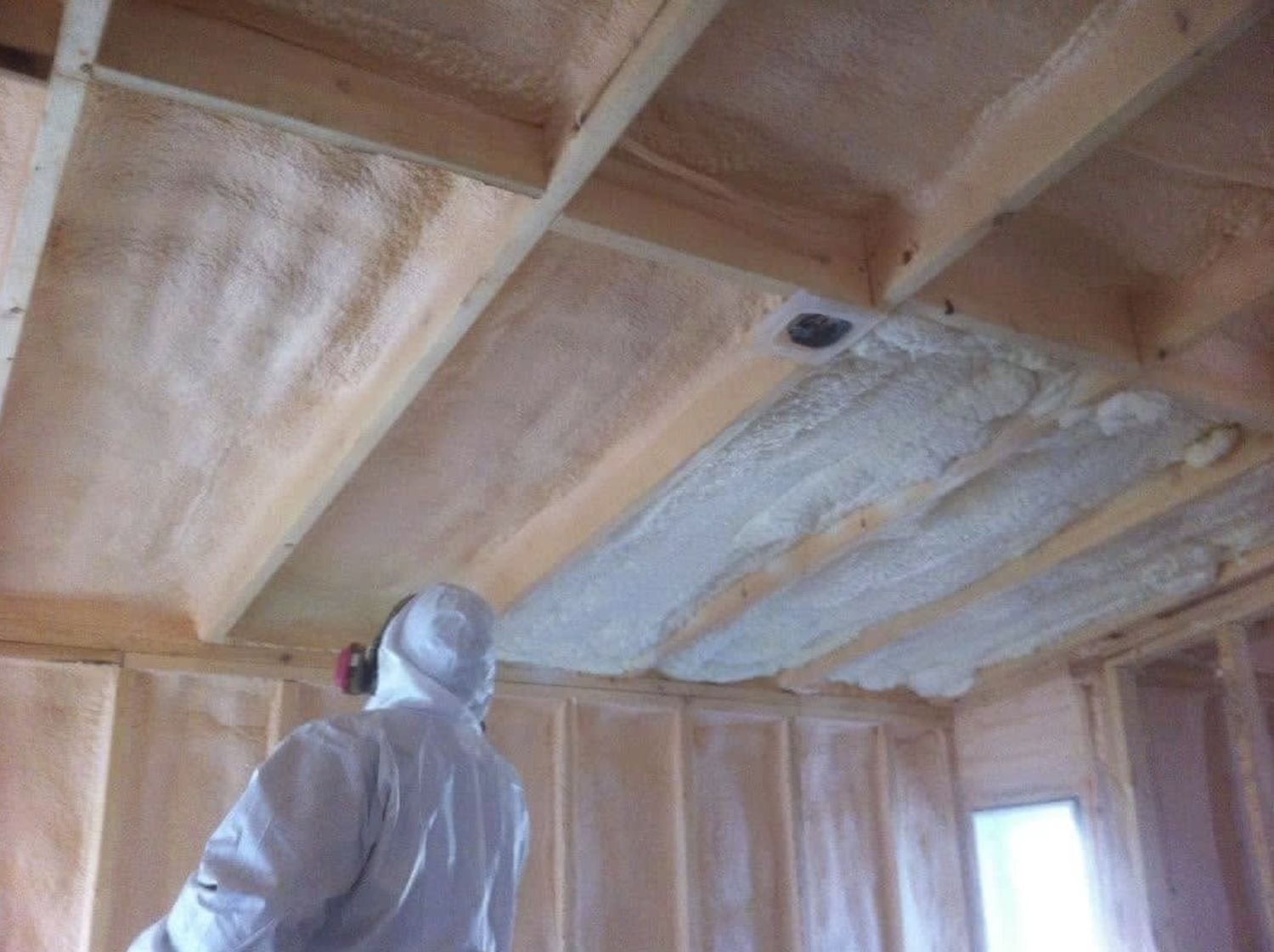
The 0.5lb light-density open-cell foam in the Grizzly product line, made in Ontario by CUSE, the same Canadian manufacturer as our 2lb closed-cell (CCMC 14133-L) and 3lb roofing foam. Ecologic is licensed for all three, which means the recommendation you get is driven by your assembly, not by the one product a contractor happens to carry. The foam is fully water-blown, Greenguard Gold certified for low chemical emissions, and passed CAN/ULC-S774 VOC testing at 24 hours.
Installed by CUFCA-certified installers: photo-ID licensing, daily self-tests, third-party audits, $2M liability coverage.
02 Where it fits
Three legitimate uses in a 5,670 heating-degree-day climate
Winnipeg sits in NBC climate zone 7A. Advice written for Ontario or the US south does not transfer. Here is where open-cell holds up under our conditions.
Sound attenuation
Interior partitions
Bedroom-to-bathroom walls, home offices, media rooms, floor cavities under bonus rooms. Open-cell's soft structure absorbs airborne sound (voices, TV, plumbing runs) and unlike batts it fills the cavity completely, including around electrical boxes and pipe penetrations where sound flanks through. A tested wall assembly with this foam rates STC-52 (ASTM E90). Interior walls have no vapour drive to manage, so the material's one big weakness is irrelevant here.
Above grade, with poly
Selected wall and ceiling cavities
Some above-grade assemblies (deep framed walls, certain vaulted ceilings with adequate depth) can take open-cell, provided a 6-mil poly vapour barrier goes on the warm side, sealed, per NBC 9.25. The foam handles the air-sealing; the poly handles the vapour. Skip the poly in this climate and interior moisture will find the cold sheathing. We spec the whole assembly, foam and poly together.
Budget-driven volume
Large above-grade areas
Where a job covers a lot of above-grade area, cavity depth is generous and the code R-target can be met with thickness, open-cell's lower material cost can carry the day. The trade-off is honest: more inches, plus poly, for fewer dollars. When the numbers favour it, we'll show you both options priced side by side and let the arithmetic decide.
03 Where it doesn't
The places we will not install open-cell, at any price
Every entry on this list is a moisture failure we would be building into your house.
Below grade and against concrete. Winnipeg foundation walls are cold and damp for most of the year. Open-cell against concrete absorbs that moisture and passes vapour toward the cold face. The result over time is a wet wall assembly. Closed-cell tolerates the moisture and is its own vapour barrier at 2 inches. This one is not a judgment call.
Rim joists. The rim is the coldest wood in the house and the hardest place to detail poly. Vapour-open foam on a rim joist puts condensation risk directly on structural framing. Rims get closed-cell, full stop.
Crawl spaces. Ground moisture, cold surfaces, minimal ventilation. Everything about a Manitoba crawl space punishes a foam that holds water.
Steel buildings. Steel skin at -30° is a condensing surface. A vapour-open foam against it collects frost inside the foam layer, then drips in the spring thaw. Quonsets, shops and barns take closed-cell.
Any assembly where vapour-open hurts. Cathedral roofs with cold sheathing and no vent path, walls with exterior layers that can't dry outward, cold storage. If interior moisture can reach a cold surface through the foam, open-cell is the wrong product. In zone 7A, that describes a lot of assemblies.
A contractor who only sprays open-cell has a reason to talk you past this list. We carry both foams, so we don't.
04 Head to head
Open-cell vs closed-cell, on the properties that decide jobs
| Property | Open-cell (0.5lb) | Closed-cell (2lb) |
|---|---|---|
| Nominal density | 0.5 lb/ft³ | 2 lb/ft³ class (34.5 kg/m³ min site density) |
| R-value per inch | R-3.5 (ASTM C518) | R-5.3–R-6.0 LTTR, rises with depth (R-11.1 @ 2 in) |
| Vapour barrier | No — 1580 ng/(Pa·s·m²) @ 25 mm; needs 6-mil poly (NBC 9.25) | Yes, at 50 mm (39 ng/(Pa·s·m²) design) |
| Air seal | Yes — excellent cavity fill | Yes — code-recognized air barrier |
| Water behaviour | Absorbs and holds | Moisture-tolerant |
| Below grade / concrete | Never | The standard answer |
| Sound absorption | Strong — STC-52 wall assembly (ASTM E90) | Modest — rigid structure |
| Structural rigidity | None — soft, flexible | Stiffens the assembly (175 kPa, ASTM D1621) |
| Cost per board foot | Lower | Higher ($1.75–$2.50/bf Prairie markets) |
| Cost per unit of R | Gap narrows — ~1.7 in to match 1 in of closed-cell | More R in less depth |
05 Cost
Cheaper per board foot. Installed cost is another question.
Open-cell uses about a quarter of the material per cubic foot, so the installed price per board foot sits well below closed-cell, which runs $1.75–$2.50 per board foot in Prairie markets. That price gap is the appeal, and in the right assembly it holds up.
Two things eat into the saving. You need roughly 1.7 inches of open-cell to match the R-value of one inch of closed-cell, so deep targets take more material than the per-foot price suggests. And the 6-mil poly vapour barrier open-cell requires in our climate is a labour line closed-cell doesn't carry. Where cavity depth is generous, open-cell can still win. Where depth is tight (2x4 walls, rims, shallow roofs) it usually can't.
Where both products are legitimate for your assembly, our written quote prices both, with the R-value math shown, and Efficiency Manitoba rebate figures where the job qualifies (rebates require CCMC-listed LTTR values and pre-approval before work starts).
06 Questions
Open-cell, answered
Open-cell or closed-cell in Manitoba?
In most Manitoba assemblies, closed-cell. Below grade, on rim joists, in crawl spaces and on steel, closed-cell's vapour barrier and moisture tolerance are not optional. Open-cell fails there. Open-cell earns its place in interior partitions for sound, and in some above-grade wall or ceiling cavities where budget drives the job and a 6-mil poly vapour barrier is going up anyway. We install both and quote whichever the assembly actually calls for.
Does open-cell need a vapour barrier?
Yes. Open-cell is vapour-open: its water-vapour permeance is 1580 ng/(Pa·s·m²) at 25 mm, so moisture vapour passes through it. In our climate the building code (NBC 9.25) requires a vapour barrier on the warm side, so open-cell gets a separate 6-mil poly layer, installed and sealed the same way it would be over batts. Closed-cell at 2 inches is its own vapour barrier; open-cell never is, at any thickness we would realistically spray.
Source: NBC 9.25
Is open-cell cheaper?
Per board foot, yes: less material per volume, lower installed cost. Per unit of R the gap narrows: roughly 1.7 inches of open-cell matches one inch of closed-cell, and the poly layer adds labour closed-cell doesn't need. When the assembly suits open-cell, the savings are real. When it doesn't, that low price ends up costing you. We price both on the written quote where both are legitimate.
Can open-cell go in my basement?
No. Open-cell absorbs and holds water, passes vapour freely, and sits against concrete that is cold and damp for much of the year in Winnipeg. That puts a moisture reservoir on the wrong side of your wall. Below grade and against concrete we install closed-cell only. It tolerates moisture and brings its own vapour barrier at 2 inches. Any contractor quoting open-cell for a Manitoba basement is quoting the wrong product.
See: basement insulation
Is it good for soundproofing?
Good at absorbing airborne sound (voices, TV, plumbing noise) in interior partitions and floor cavities, and it fills the framing gaps batts leave open. A tested wall assembly with this foam rates STC-52 (ASTM E90), and the foam carries Greenguard Gold certification for low chemical emissions. It is not a cure for low-frequency noise like bass or footsteps; that takes mass and decoupling (double drywall, resilient channel). We'll tell you which problem you have before you pay to fix the wrong one.
Get a quote that prices both foams honestly.
Measured areas, the right product per assembly, R-value math shown. In writing.