Residential · Foundation Walls & Rim Joists
Basement insulation in Winnipeg
Direct answer
Winnipeg basements sit in expansive Red River clay, and their concrete walls are damp more often than homeowners think. The insulation has to tolerate that. Closed-cell spray foam applied directly to the foundation wall insulates (verified R-11.1 at 2 inches, R-17.5 at 3), air-seals and vapour-seals in one pass, with nothing organic against the concrete to feed mould. Ecologic installs it to CAN/ULC-S705.2, seals the rim joists while we're there, and handles the Efficiency Manitoba rebate. Foundation walls currently earn $0.06 per ft² per R-value added, pre-approval required.
Sources: CCMC 14133-L · NRCan "Keeping the Heat In" §6 · efficiencymb.ca (verified July 2026)
01 Site conditions
Your foundation lives in gumbo. Design for that.
Winnipeg is built on lacustrine clay — the lake-bottom "gumbo" that swells when wet and shrinks when dry, working foundations season after season. Practical consequences for insulation: concrete walls that see moisture cyclically, hairline cracks that come and go, and cool wall surfaces that condense interior humidity for much of the year.
That's why the material question matters more here than in most cities. Fibre insulation against a Winnipeg foundation wall is a moisture sponge waiting for its year; anything organic in that first layer is mould food. The first layer against the concrete needs to be something water can't degrade.
Natural Resources Canada's basement guidance ("Keeping the Heat In," Section 6) covers the same ground for every Canadian climate. We'd rather you read it than take our word.
Why batts + poly fail here
1. Concrete releases moisture into the batt.
2. The poly traps it in the stud cavity.
3. The cool concrete face condenses interior air that leaks behind the frame wall.
4. Wet fibreglass insulates poorly; damp wood and paper feed mould.
Foam on the concrete removes the condensation surface and the food source at once. It costs more up front, and it's still working in fifteen years.
02 The assembly
Foam on concrete, frame inside, finish anything you like.
Inspect the walls
Active leaks get fixed before insulation. Foam covers walls; it doesn't cure drainage problems. We check cracks, efflorescence and grade conditions first, and we'll say so if you need a foundation contractor before an insulation one.
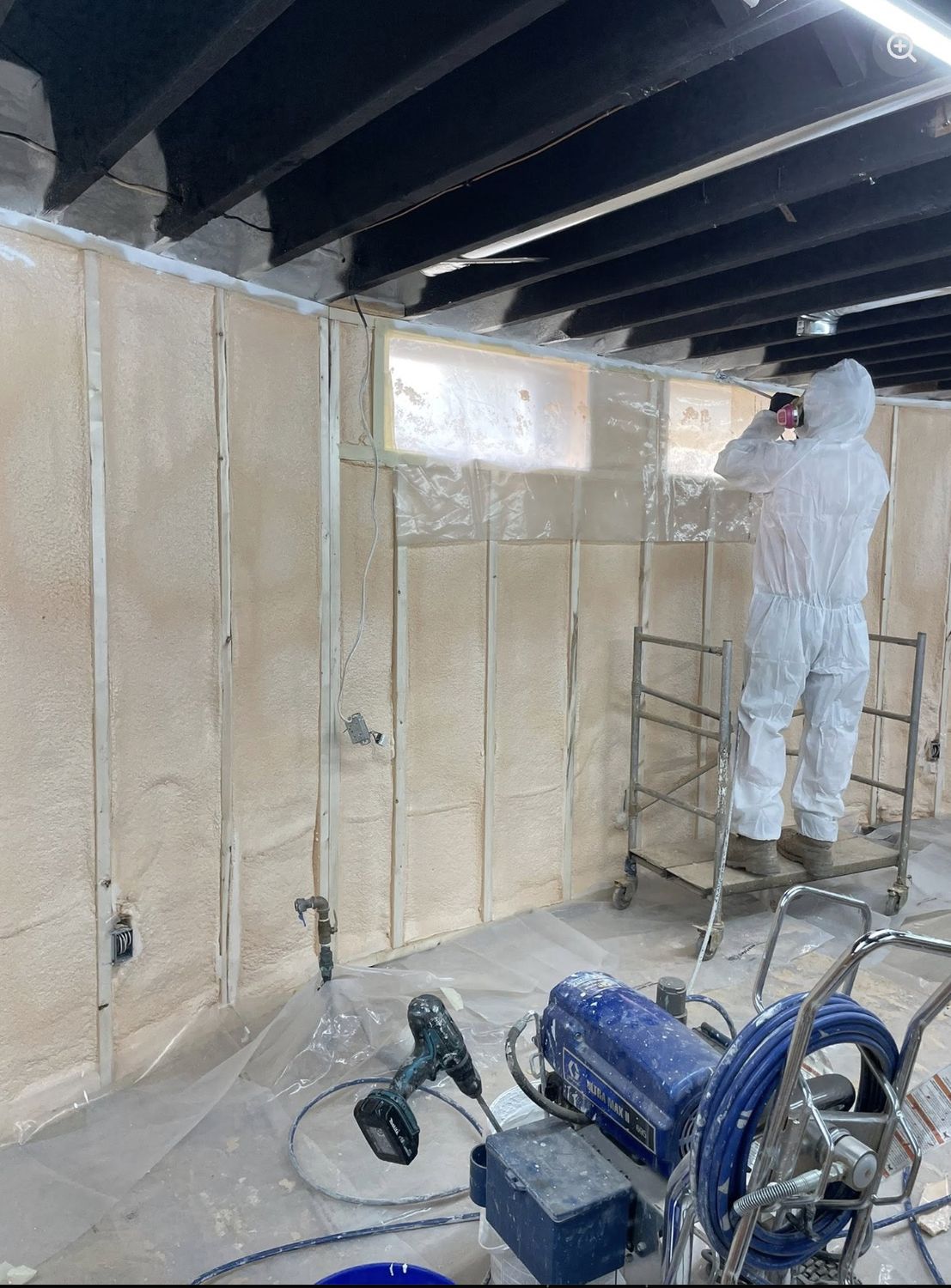
Spray the foundation wall
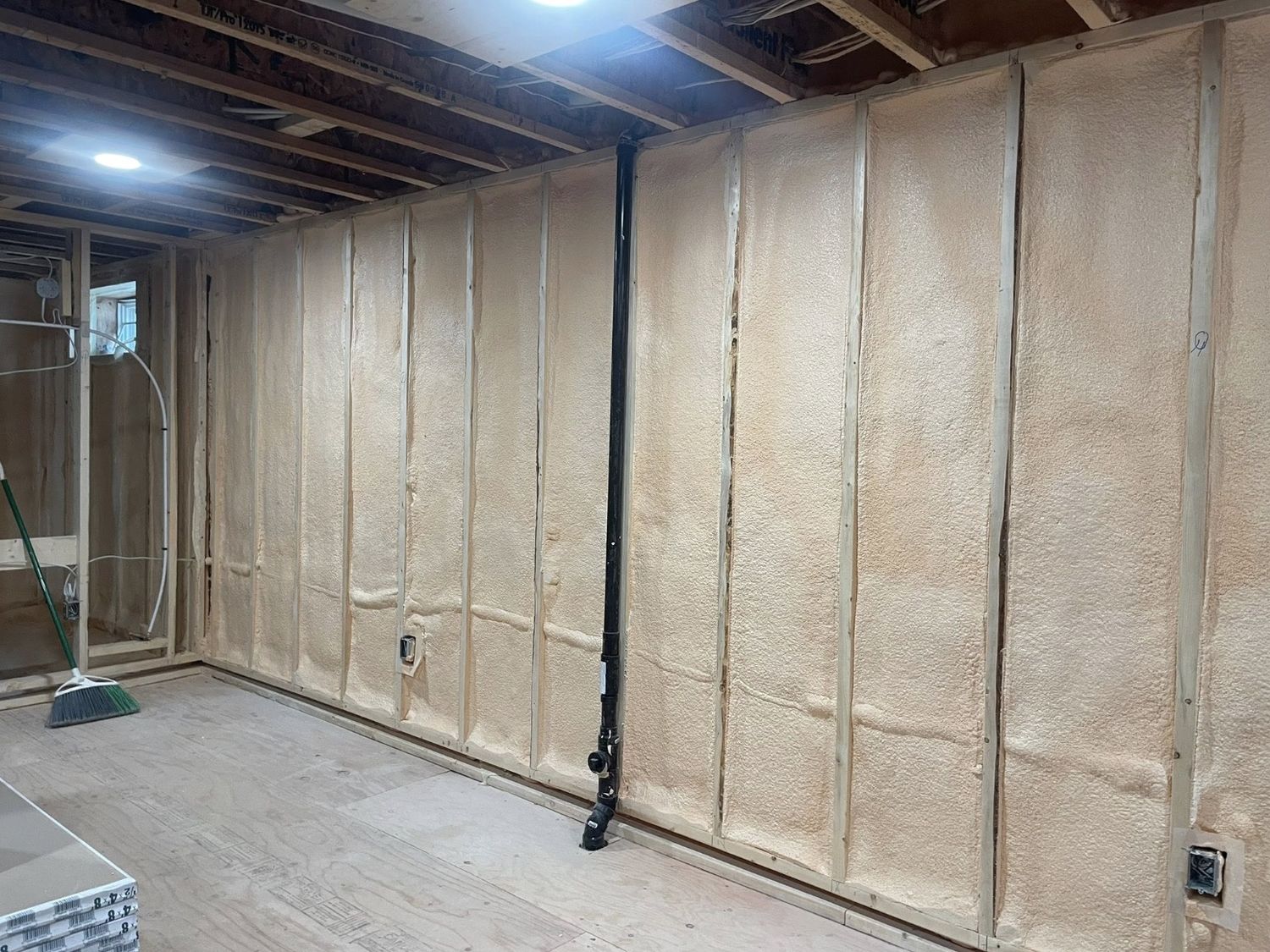
Closed-cell foam direct to concrete, typically 3 inches for the zone 7A code target of about R-17 effective (with HRV). Fully adhered: no air gap behind the insulation for condensation or radon to travel.
Seal the rim joists
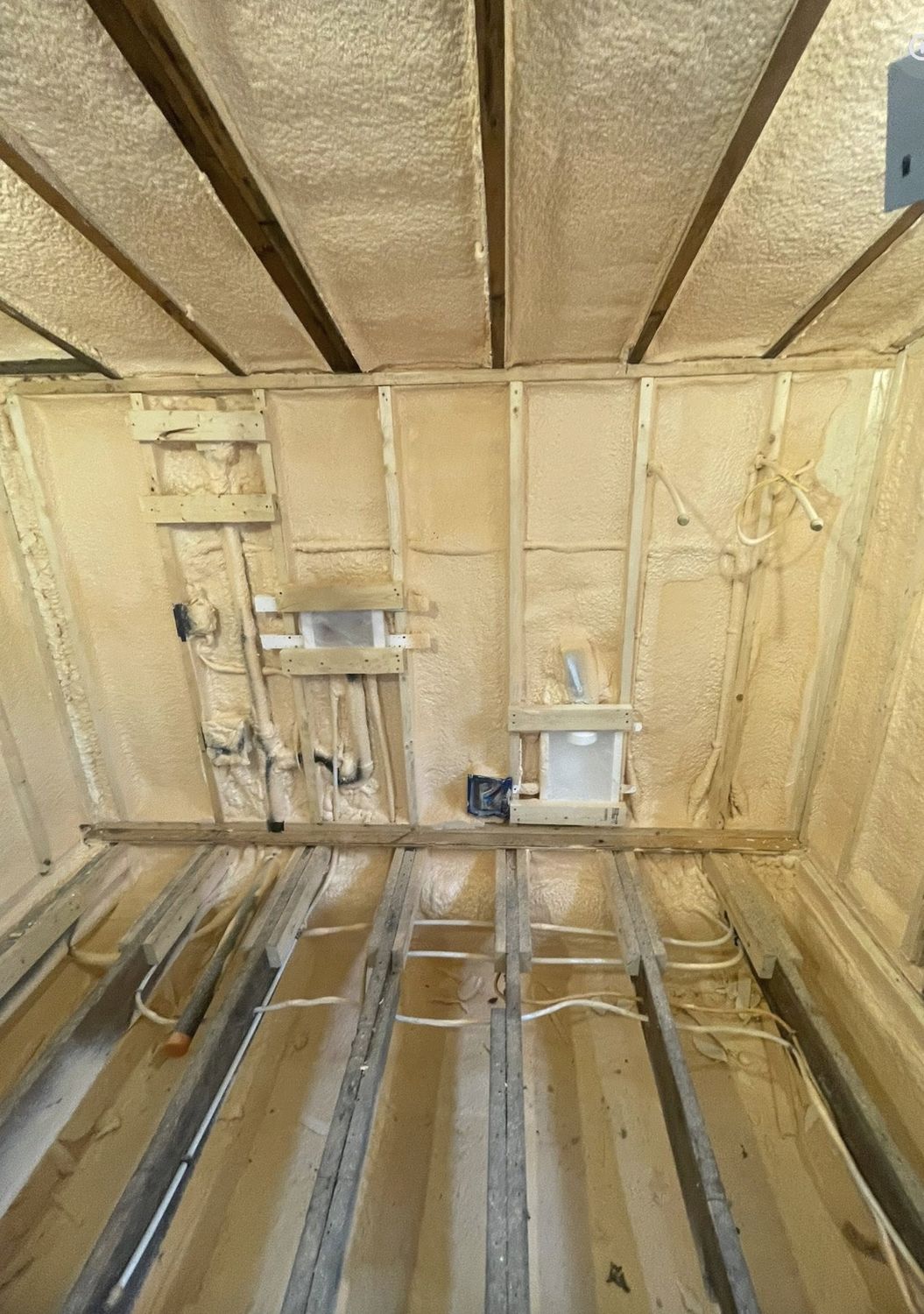
Same visit, same rig: 2–3 inches around the perimeter band. Highest-return foam in the house (details below).
Frame and finish
The stud wall goes inside the foam, cavities stay dry and empty (or take cheap sound batts), and the code's thermal-barrier requirement is met by your drywall. We document what was sprayed, where, at what thickness.
03 Rim joists
The leakiest 40 square feet in the house.
Around the top of your foundation, the floor framing rests on the concrete: a perimeter of end-grain lumber, sill gaps, and every hole the trades ever drilled for wiring, plumbing and gas. Per square foot, this band typically leaks more air than any wall or window in the building. In February that leak is a -30° draft delivered directly under your floor.
Batts stuffed into rim bays do almost nothing; air moves straight through fibre. Closed-cell foam does the whole job at once: seals the leaks, insulates the wood, and closes off a common radon entry route at the slab-wall and sill joints. If your budget only covers one piece of basement work this year, it should usually be this one.
04 Rebates
Foundation walls carry the richest rebate rate. Check eligibility first.
Efficiency Manitoba pays $0.06 per ft² per R-value added on foundation walls (double the attic rate), capped at the insulation material cost. Worked example: 800 ft² of wall taken from bare concrete to R-17.5 (3 inches of foam) earns $0.06 × 800 × 17.5 = $840.
Eligibility depends on your heat source and what's on the walls now: gas-heated homes qualify when the basement is currently uninsulated; electric, propane, oil or wood-heated homes qualify at R-12 or less existing. Pre-approval must be in place before work begins, and only CCMC-verified R-values count. Our foam's listing is exactly that paperwork.
Income-qualified households should ask us about the Energy Efficiency Assistance Program before quoting; it can cover insulation entirely.
| Parameter | Value |
|---|---|
| Foundation rebate rate | $0.06 / ft² / R added |
| Cap | Insulation material cost (incl. tax) |
| Gas-heated eligibility | Currently uninsulated |
| Electric/propane/oil/wood | Existing ≤ R-12 |
| Pre-approval | Before work starts |
| R-value basis | CCMC-verified LTTR only |
05 Questions
Basements, answered
What's the best way to insulate a Manitoba basement?
Moisture-tolerant insulation applied directly to the concrete (closed-cell foam is the standard), then frame inside it. Three inches meets the zone 7A effective target (with HRV); two inches is where the foam becomes your vapour barrier.
Sources: NRCan Keeping the Heat In §6 · NBC 2020 9.36
Why not batts and poly? It's cheaper.
Because in damp-prone Winnipeg conditions it's the assembly most likely to end up mouldy: batts wick the wall's moisture, poly traps it, the cold concrete face condenses whatever interior air sneaks behind the framing. Cheap that has to be redone isn't cheap.
Should I do rim joists even if I skip the walls?
Yes. It's usually the highest-return foam work in the house: the leakiest area per square foot, sealed, insulated and radon-hardened in a single small job.
Will my job get the rebate?
Foundation walls earn $0.06/ft² per R added if you're eligible (gas heat: currently uninsulated; other fuels: ≤R-12 existing) and pre-approved before work starts. We confirm and file with you before booking.
Source: efficiencymb.ca, verified July 2026
What does a basement cost?
Prairie closed-cell runs $1.75–$2.50 per board foot installed; an 800 ft² wall at 3 inches is 2,400 board feet, and the same job can earn ~$840 back in rebate. The quote is written, with the math shown.
06 Timing
Cold outside doesn't mean waiting until spring.
Basement insulation is indoor work — foam applied to a foundation wall inside a heated basement, not outdoor work exposed to the weather. A Manitoba winter is exactly when a cold, uninsulated basement gets noticed, and exactly when exterior trades slow down and stop competing for the same renovation calendar.
Get the basement assembly that's still dry in fifteen years.
Inspection first, written quote with rebate eligibility confirmed.