Soil-Gas Sealing · Closed-Cell Foam
Radon gas barriers in Winnipeg
Direct answer
Manitoba has one of Canada's worst radon problems: Health Canada's 2012 Cross-Canada Survey found 19% of Manitoba homes above the 200 Bq/m³ guideline, with some regions over 40%. Radon enters through the slab-wall joint, foundation cracks, sump openings and service penetrations. These are the same gaps closed-cell spray foam seals. Foam sealing closes those soil-gas entry paths and supports radon control. It does not replace testing, and where levels are high it does not replace active mitigation by a certified radon professional. Our advice in one line: test first with a long-term winter test, seal what should be sealed, mitigate if the numbers say so, then test again.
Sources: Health Canada 2012 Cross-Canada Survey · Health Canada radon guideline · manufacturer product evaluation
01 The problem
One Manitoba home in five is over the guideline
Radon is a radioactive gas produced by uranium decaying in soil and rock. It has no colour, no smell and no taste. Outdoors it disperses to nothing. Indoors it accumulates, especially in a house closed up through a Manitoba winter.
The health case is not speculative. Health Canada identifies long-term radon exposure as the second leading cause of lung cancer after smoking. The risk builds slowly, over years of breathing it, and it is higher for smokers. Nobody should be frightened by a page on a contractor's website; everybody in this province should know their number.
Manitoba's geology is why it matters here more than most places. Health Canada's 2012 Cross-Canada Survey found 19% of Manitoba homes above the 200 Bq/m³ guideline, among the highest provincial rates in Canada, and some Manitoba regions test over 40%. The only way to know where your house falls is to test it.
02 Entry paths
Your house inhales soil gas all winter
Warm air rising through the house creates suction at the foundation: the stack effect. Soil gas follows the pressure difference through every opening it can find.
The main entry routes
The slab-wall joint. The perimeter crack where the basement floor meets the foundation wall: a continuous opening around the entire footprint, and usually the largest single entry path.
Sump pits and floor drains. A sump is an open hole to the soil unless it is sealed with a fitted, gasketed lid.
Cracks and cold joints. Shrinkage cracks in the slab and walls, routine in Winnipeg's clay, and each one a route in.
Service penetrations. Water lines, sewer stacks, gas lines, electrical conduits: every hole cored through the foundation.
The rim joist area. Where the wood structure sits on the foundation: leaky in both directions, letting soil gas that migrates up the exterior foundation face enter at the sill.
Two Winnipeg-specific notes. First, our expansive clay moves foundations seasonally, which keeps opening new cracks over a house's life, so soil-gas sealing here is never a one-crack story. Second, the colder the winter, the stronger the stack effect: the same house draws more soil gas in January than in June, which is also why winter is when testing tells the truth.
Notice that every entry path on this list is also an air-leakage path. That is the overlap this service lives in: the work that seals a basement against heat loss (foam at the rim joists, the slab-wall joint, the penetrations) is the same work that closes radon's routes in. One mobilization addresses both.
03 The honest scope
What foam sealing does for radon, and what it does not
This section exists because too much radon marketing overpromises. Read both columns before you spend money with us or anyone else.
What it does
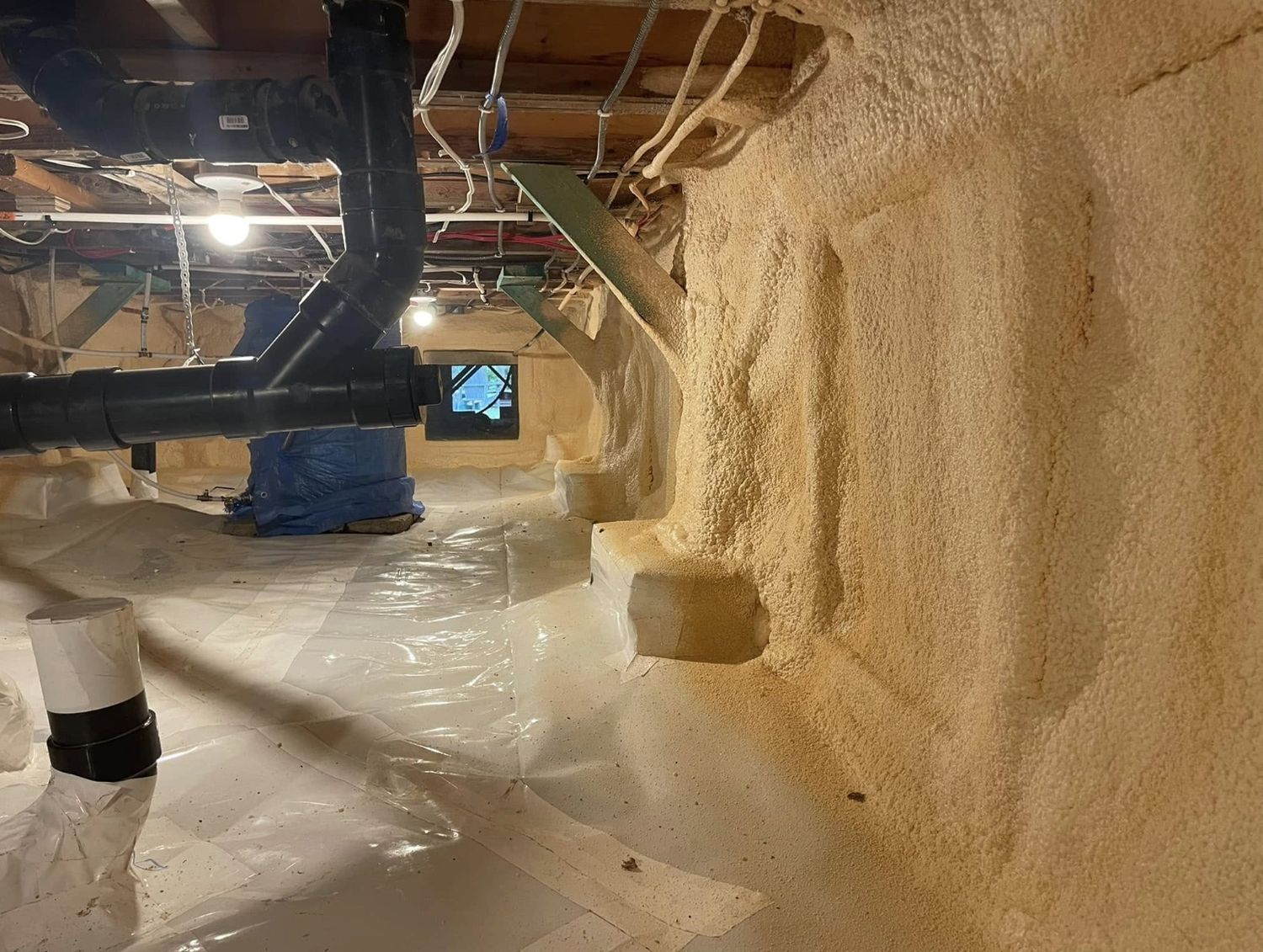
Closed-cell foam is an air barrier that adheres to concrete and fills irregular gaps. Applied to the slab-wall joint, foundation cracks, rim joists and service penetrations, it closes the pressure-driven entry paths soil gas uses. This is the entry-route sealing Health Canada lists among radon control measures.
The foam system we install carries a radon control product evaluation (RADON RCS, maintained through CUFCA with UL Solutions), per the manufacturer, which means the material's suitability for soil-gas control work has been formally evaluated rather than just asserted.
Sealing also makes active mitigation work better: a sub-slab depressurization fan holds stronger vacuum under a slab whose edges and penetrations are sealed.
What it does not
It does not replace testing. Sealing without a before-and-after test is spending money blind. No contractor, us included, can look at a basement and tell you its radon level.
It does not replace active mitigation. Where a long-term test comes back high, the proven fix is a sub-slab depressurization system installed by a certified radon mitigator (C-NRPP). Sealing supports that system; it does not substitute for it.
It does not carry a guaranteed reduction number. Houses differ. Anyone quoting you a percentage reduction from sealing alone is guessing. We won't.
If your test result is high, our first advice is a certified mitigator. We'll do the sealing that helps their system work.
04 First step
Test first. We mean it, even when it delays our work.
Radon levels swing daily and seasonally, so Health Canada's guidance is a long-term test of at least three months during the heating season, when closed-house conditions show the real exposure. A cheap alpha-track detector sits on a shelf in the lowest lived-in level; you mail it to the lab when the period ends.
The number decides everything that follows. Under 200 Bq/m³: no action required, though sealing you do for energy reasons still helps keep it low. Over 200: Health Canada recommends fixing within two years, and within one year over 600. That means a certified mitigator, with sealing in a supporting role.
Test kits are available from lung-health organizations and hardware retailers for less than a service call costs. Do that first. This page will still be here.
The sequence that actually works
1. Test. Long-term detector, three months minimum, over winter, lowest occupied level.
2. Read the number. Under 200 Bq/m³, you're below the guideline. Over it, plan remediation on Health Canada's timelines.
3. Seal the entry paths. Foam at the slab-wall joint, cracks, rims and penetrations, for its own sake and to support any mitigation system.
4. Mitigate if needed. Sub-slab depressurization by a certified (C-NRPP) radon professional where levels are high.
5. Test again. The only proof any of it worked.
05 Where we fit
New construction, renovations and existing homes
New builds. The building code's radon provisions give new homes a rough-in: a gas-permeable layer below the slab and a capped pipe stubbed through it, ready to take a fan if the house ever tests high. Construction is the cheap moment to add the sealing layer too: foam at the slab-wall joint, rim joists and penetrations before framing and finishes bury them. Test the finished house in its first winter; if it comes back high, the rough-in makes the fix a fan installation instead of a retrofit.
Basement and crawl-space work. Most of our radon-relevant sealing happens inside jobs we're doing anyway: basement insulation, crawl spaces, rim joists. If radon is a concern, say so when we quote: we'll make sure the slab-wall joint, sump surround and penetrations are in the scope rather than left to whoever finishes the basement.
Existing homes with high tests. Our role is the supporting one: sealing the entry paths so a mitigator's sub-slab system pulls harder with less fan. We work alongside certified radon professionals, never in place of them.
One boundary worth restating: spray foam is not a radon mitigation system, and we don't sell it as one.
06 Questions
Radon and sealing, answered
How bad is radon in Winnipeg and Manitoba?
Among the worst in Canada. Health Canada's 2012 Cross-Canada Survey found 19% of Manitoba homes above the 200 Bq/m³ guideline, one of the highest provincial rates, and some regions test above 40%. Prairie geology produces the radon; the long heating season pulls it indoors through the foundation. You can't see, smell or taste it. The only way to know your number is to test.
Source: Health Canada Cross-Canada Survey, 2012
Does spray foam stop radon?
It closes entry paths; it does not, by itself, fix a radon problem. Foam seals the slab-wall joint, rim joists, cracks and penetrations soil gas uses to enter, which supports radon control and helps mitigation systems perform. But sealing is not a substitute for testing, and where levels are high it is not a substitute for sub-slab depressurization by a certified mitigator. Test, seal what should be sealed, mitigate if the numbers say so, then test again.
Source: Health Canada radon guidance
Should I test before sealing?
Yes, always. A long-term test (three months minimum, ideally over winter) gives you the starting number. Without it, nobody can say whether sealing helped or whether you needed active mitigation instead. Kits are cheap and widely available. Test first, decide second. We say this even when it delays our own work.
What is the 200 Bq/m³ guideline?
Health Canada's action level: if the long-term average in occupied areas exceeds 200 becquerels per cubic metre, Health Canada recommends remediation, within two years above 200 and within one year above 600. It's a guideline for action, not a line between safe and unsafe; Health Canada notes there is no threshold below which risk is zero, so lower is always better.
Source: Health Canada radon guideline
What about a new build?
New homes get radon rough-in provisions under the code: a gas-permeable layer under the slab and a capped pipe that can become an active system later. Construction is the cheap moment for sealing: foam at the slab-wall joint, rims and penetrations before finishes cover them. Then test in the first winter. Rough-in plus sealing keeps the fix simple if the test comes back high.
Wider reading
Building Science Hub
The regional MB/SK/NW Ontario picture: code, radon rates by province, and the science behind the sealing above.
Sealing scoped honestly, alongside your radon plan.
Test first. Then a written quote for the entry-path sealing that actually helps.